
RCF Brand Logo

SYSTEM PLANNING DESK

RCF project guidance from room brief to handover

A useful support request describes the audience, program, mounting points, electrical service and operator workflow. That context lets a dealer or integrator test assumptions before a product list hardens into a purchase order.

The path below is deliberately reviewable. It separates acoustic coverage, electrical headroom, mechanical suspension and commissioning evidence so one headline specification does not stand in for an entire system.

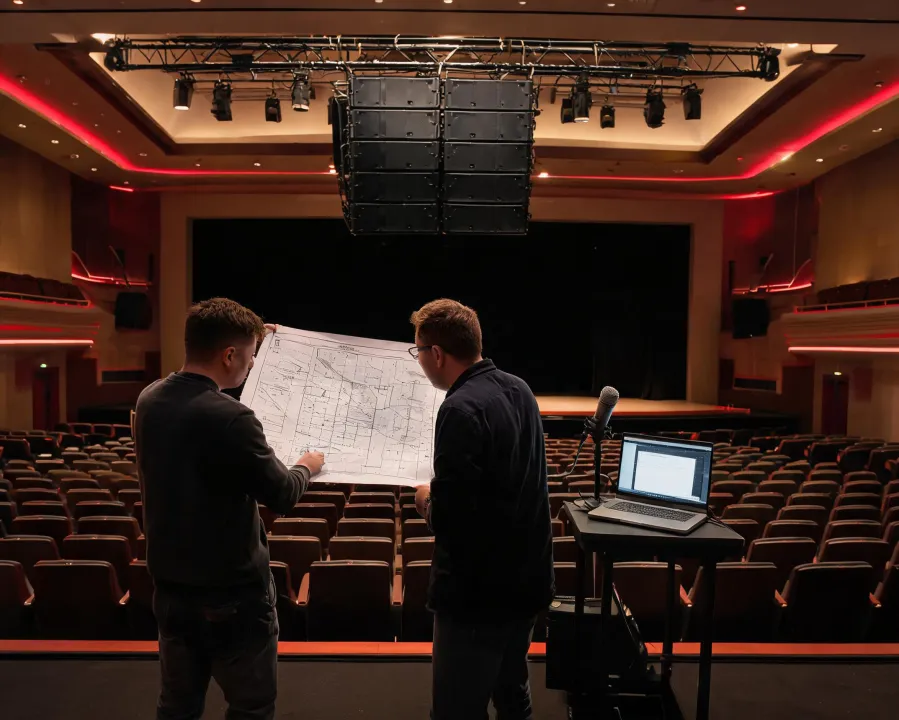
Audio engineer reviewing venue coverage and loudspeaker placement

FOUR REVIEW TRACKS

Keep each decision connected to a test

01

Coverage and level brief

Record audience width, depth and elevation; loudspeaker trim height; sightline restrictions; expected program; and the required level at representative seats. Directivity figures and maximum-SPL data are comparable only when bandwidth, distance, processing and test conditions are stated. A compact point source can be appropriate for a shallow room, while a long or tiered audience may require line-array prediction and front-fill zoning.

02

Power, processing and routing

Map source count, input sensitivity, gain structure, nominal impedance, amplifier allocation, crossover, polarity, delay and limiter preset. Powered enclosures reduce external amplifier wiring but distribute mains and service points around the venue. Passive systems centralize amplification yet require channel, load and cable-loss calculations. Neither route is universally simpler.

03

Mechanical and environmental review

Confirm working load limits, approved frames, pins and brackets, structural attachment, weather exposure, transport path and maintenance access for the exact model. Published acoustic output does not authorize a suspension method. Outdoor use, voice-alarm integration and regulated installations require project-specific documentation and approval by the responsible authority.

04

Commissioning and recovery record

Measure polarity, delay alignment, crossover behavior and representative listening positions with the microphone location, signal, bandwidth, weighting and operating level recorded. Store the approved DSP file, input routing, limiter state and a recovery preset. Handover should explain which settings are locked, which operators may change and what symptoms require a service inspection.

DECISION QUESTIONS

Resolve the trade-offs before arrival on site

These answers define boundaries rather than prescribe a model. Final values must come from current RCF documentation, prediction files, measurements and local requirements.

Powered systems place amplification and protection near the drivers, reducing separate rack specification. Passive systems can simplify centralized service and power distribution. Compare mains access, cable runs, channel count, spare strategy, weight and technician access rather than assuming either architecture has lower total complexity.

No. A maximum value without distance, bandwidth, crest factor, duration and limiting context cannot describe coverage consistency or tonal balance. Compare data under aligned conditions, then use prediction and multiple-position measurements. Exposure limits and listener comfort may set the practical boundary below the device limit.

Equalization cannot repair blocked sightlines, strong coverage overlap, insufficient directivity, reversed polarity or an unsuitable loudspeaker location. Correct geometry and timing first. Use time-windowed measurements and several seats so a local reflection does not dictate the system response.

BEFORE / AFTER THE REVIEW

A product request becomes an auditable system brief

Unresolved request

  • “Speaker for 500 people” without room dimensions
  • Power figure without load or measurement method
  • Mounting point without structural or hardware review
  • One listening position and no stored test condition

Review-ready brief

  • Audience boundary, trim height, throw and program stated
  • Coverage, bandwidth, SPL and headroom evaluated together
  • Exact approved mounting components and access recorded
  • Three or more representative positions plus recovery preset

MAKE THE FIRST REVIEW SPECIFIC

Send the geometry, not just the guest count

Include room dimensions, audience plan, mounting constraints, program material, target listening level, available power, source count and operating schedule. If measurements or drawings do not yet exist, state that gap explicitly; the response can identify what to collect next.